
How much of a lecture you forget in 30 days

In short
- One good pass at a concept has a half-life of about 41 days.
- A week later you can reach 81% of it. A month later, 56%.
- A single review on day one lifts the day-30 figure to 68%.
- The first review is the cheapest one you will ever do.
Every medical student has had the experience of opening a deck they sat through six weeks ago and recognising almost none of it. Not the diagrams, not the classification, not the drug that was clearly important enough to get its own slide. The lecture happened. You were there. You understood it at the time. And now it is gone.
The uncomfortable part is that nothing went wrong. That is simply what memory does when it is left alone, and it does it on a schedule you can predict with reasonable accuracy.
We wanted to put numbers on it, so we ran the decay directly.
What we did
We used FSRS, the open-source scheduler behind much of the modern spaced-repetition world, as our memory model. Its forgetting curve is a power function rather than the exponential curve most people picture — written out, R = (1 + 0.2346 × t / S) ^ -0.5.
R is the probability you can retrieve the item today, t is days since you last looked at it, and S is stability — how durable that particular memory currently is, measured in days. Stability is the number that everything else hangs off: raise it and the whole curve flattens.
We took a single concept, learned once and understood properly the first time, which in FSRS terms means an initial stability of 3.17 days. Then we let the clock run for a month without touching it, and separately, ran the same concept with exactly one review on day one.
Everything below comes out of that model. We are simulating a well-characterised curve, not testing students in a lab — more on what that does and does not license at the end.
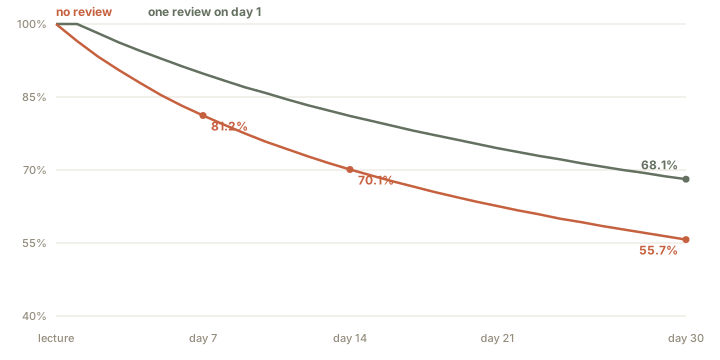
The shape of the loss
The half-life — the point where you are as likely to fail as succeed — lands at 40.6 days.
That number is worth sitting with, because it cuts against the folk version of forgetting. The popular image is a cliff: you know it, you know it, then suddenly it is gone. What the curve actually shows is a steep initial drop followed by a very long tail. The first week is expensive. The fourth week is comparatively cheap, because most of what was going to fall away has already fallen.
| Days since the lecture | Chance you can retrieve it |
|---|---|
| 1 | 96.5% |
| 7 | 81.2% |
| 14 | 70.1% |
| 30 | 55.7% |
Losing 19% in the first week is the part that surprises people. It is also the part that explains a familiar experience: reviewing something a week later feels harder than it “should”, and students routinely read that difficulty as a personal failing rather than as the predictable behaviour of an untouched memory.
One review changes the arithmetic
Now the same concept, reviewed once, twenty-four hours after the lecture.
That single review moves stability from 3.17 days to 5.87 — it nearly doubles the durability of the memory. The curve does not just shift upward, it flattens, because stability controls how fast the whole thing decays.
At day 30 the reviewed concept sits at 68.1% against 55.7% for the untouched one. Twelve and a half percentage points, bought with one pass over material you had already seen.
The leverage comes from timing rather than effort. Reviewing on day one is cheap precisely because you still mostly know it: recall is fast, nothing needs re-reading from scratch, and the whole thing takes seconds. Wait three weeks and the same review costs far more, because now you are partly relearning.
The first review is not where you learn the material. It is where you decide how long the material is going to last.
Why this is hard to act on
None of this is new. Ebbinghaus published the shape in 1885, and every medical student has been told to review promptly. The advice fails in practice for a reason that has nothing to do with willpower.
To act on it, you need to know which concepts are due, when, across every lecture you have ever attended. After one week that is a manageable list. After one semester, with eight hundred concepts in flight, each on its own curve with its own stability, it is not a list any person can hold. The scheduling problem defeats people long before the reviewing problem does.
This is exactly the gap that spaced-repetition software was built to close, and it is what Forgetting does inside KoiSwarm — it tracks the stability of each concept you have studied and surfaces the ones crossing the threshold, so the decision of what to review today is not yours to make. Notes feeds it: when a lecture deck becomes structured notes, the concepts in it become individually trackable rather than a single undifferentiated blob called “the cardiology lecture”.
The practical version of the finding is unglamorous. Do one pass over today’s lecture before you sleep. Not a re-read — a genuine attempt at recall, with the slides closed. It costs a few minutes and it is the highest-return few minutes available to you that day.
What this model does and does not show
These are simulations of a published memory model, not measurements of students. That distinction matters, so here is what it buys and what it does not.
FSRS was fitted on hundreds of millions of real reviews, so the shape of these curves and the relative sizes of these effects are well grounded. What it cannot tell you is your personal stability for a specific concept. Individual variation is large, difficult material decays faster than easy material, and a concept you genuinely understood behaves differently from one you merely recognised.
We also modelled a clean single exposure. Real lectures are messier: you half-knew some of it already, you were distracted for ten minutes in the middle, and one slide connected to something you learned last year and will therefore outlive everything around it.
Treat the numbers as the right order of magnitude and the right direction, not as a personal forecast. The direction is the useful part, and the direction is unambiguous: the review you do tomorrow is worth several of the ones you will do in three weeks.
Model: FSRS-5, default published parameters. The simulation code and outputs behind this article are the same ones used across this series.