
Cramming vs spaced repetition for medical exams

In short
- Cramming scored 99.1% on exam day against 95.4% for spaced review.
- Ninety days later that reverses: 65.4% against 77.3%.
- Cramming required 5,600 reviews to spaced review's 3,366.
- The memories it built were 3.3× less stable.
Most writing about cramming starts from the assumption that it does not work, and then explains why you should feel bad about it. We went in expecting to produce a version of that article. The simulation refused to cooperate, and the result is more interesting than the one we set out to write.
Cramming works. On exam day it beat distributed review by a clear margin. Any student who has crammed successfully already knows this, which is precisely why being told otherwise has never changed anyone’s behaviour.
The case against it has to be made somewhere else.
The setup
We modelled a realistic block: 800 concepts, an exam twelve weeks out, using FSRS-5 with its published parameters. Each run was repeated twenty-five times with different random seeds, because whether you successfully recall a given item on a given day is probabilistic — an item at 85% retrievability fails roughly one time in seven, and those failures cascade differently each run.
Two strategies:
Cramming. Nothing happens for eleven weeks. In the final seven days every concept is learned and then reviewed once daily until the exam.
Spaced review. Concepts are learned steadily across the run-up. Each one is reviewed whenever its retrievability decays to 90%, which is FSRS’s default target — early enough to be reliable, late enough to be worth doing.
Both strategies were then followed past the exam, with no further review, to see what survived.
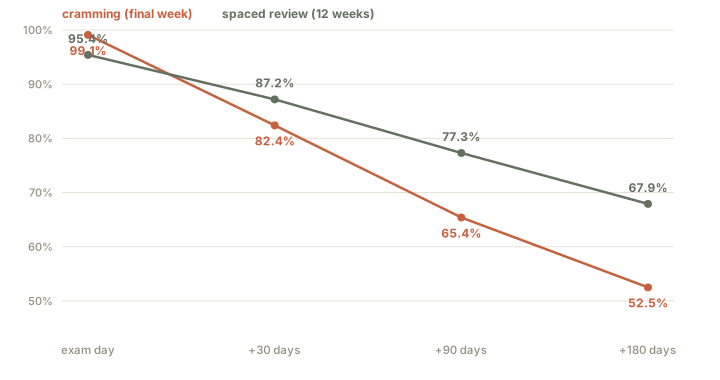
Exam day goes to the crammer
| Exam day | +30 days | +90 days | +180 days | |
|---|---|---|---|---|
| Cramming | 99.1% | 82.4% | 65.4% | 52.5% |
| Spaced review | 95.4% | 87.2% | 77.3% | 67.9% |
Cramming finishes 3.7 points ahead on the day that counts. The standard deviation across runs was 0.03, so this is not noise.
The mechanism is not mysterious. On exam morning the crammer last touched every single concept somewhere between one and seven days ago. Retrievability is a function of elapsed time, and almost no time has elapsed. The spaced student, by contrast, is walking in with items that were last reviewed at various points across three months, deliberately allowed to drift down toward 90% before being topped up.
If your honest objective is to pass one exam and never think about the material again, the simulation says cram. We would rather say that plainly than pretend the data says something more convenient.
What it costs
Two things undercut the win, and both are invisible on results day.
It is more work, not less. Cramming consumed 5,600 reviews. Spaced review consumed 3,366. That is 66% more work for the strategy everyone thinks of as the shortcut — seven passes over every concept versus 4.2. The reason is that reviews done a day apart are nearly worthless: the memory has barely decayed, so there is little to strengthen. You are paying full price for a fraction of the benefit. We took that apart properly in a separate experiment on review timing.
The memories are structurally weaker. At exam time, the crammer’s concepts had a mean stability of 16.9 days. The spaced student’s sat at 55.4 days — 3.3× more durable. Same apparent knowledge on the day, built on foundations that differ by a factor of three.
Stability is what governs the slope of everything that follows. It is why the two curves diverge so sharply after the exam, and it is not something you can see by testing yourself on exam morning. Both students would have told you they knew the material. Only one of them was right in any lasting sense.
The part that matters for medicine
By ninety days out the ordering has inverted and the gap is 11.9 points in the other direction. By six months it is 15.4 points.
For most degrees this is a footnote. For medicine it is the whole point. The cardiology you learn in second year is load-bearing for the cardiology you are examined on in Step 1, the cardiology you are asked about on the ward, and the cardiology you will practise. A strategy that reliably converts to 52.5% at six months is not a study method. It is a way of renting knowledge.
Cramming is not irrational. It is a correct solution to the wrong problem — optimising for a date instead of a career.
There is also a compounding effect the simulation does not capture. Every block you cram becomes a block you have to relearn from close to scratch when it reappears, so the total work grows over a degree rather than shrinking. The spaced student’s third-year revision starts from 68% and mostly needs topping up. The crammer’s starts from 52% and needs rebuilding.
Why students cram anyway
Not laziness. Scheduling.
Distributed review is only cheaper if something tells you what is due today. Without that, “space your repetitions” is an instruction to manually track eight hundred decay curves, which is not a thing anyone does. The fallback — reviewing whatever feels shakiest — systematically overweights recent material and quietly abandons everything from two months ago. Cramming at least has the virtue of being a plan you can actually execute.
This is the specific problem Forgetting exists to solve inside KoiSwarm: it holds the stability estimate for every concept you have studied and tells you which ones have crossed the threshold today, so the distributed strategy becomes something you follow rather than something you organise. Planning works the other end of it, shaping the intake against your exam date so the run-up does not compress into a spike — the failure mode we measured in our start-date experiment.
The finding here is not that you should feel guilty about cramming. It is that cramming is the more expensive option in every respect except the one you can see.
Limits of the model
These are simulations of a memory model, not a trial with students. FSRS was fitted against a very large corpus of real reviews, so the shape and relative magnitude of these effects are well grounded, but three caveats apply.
The model has no concept of understanding — it treats a memorised fact and a deeply integrated mechanism identically, and in reality the latter decays far more slowly. It also cannot represent the interference between similar items that makes eleven adrenergic receptor subtypes harder than eleven unrelated facts. And our crammer is idealised: they successfully learn 800 concepts in seven days without fatigue, which no human does. A realistic crammer would perform worse than the one we simulated.
Every one of those caveats runs the same direction. The gap we measured is, if anything, conservative.
Model: FSRS-5, default published parameters. 800 concepts, 84-day horizon, 25 runs per condition, target retention 90%.