
How much time spaced repetition takes per day

In short
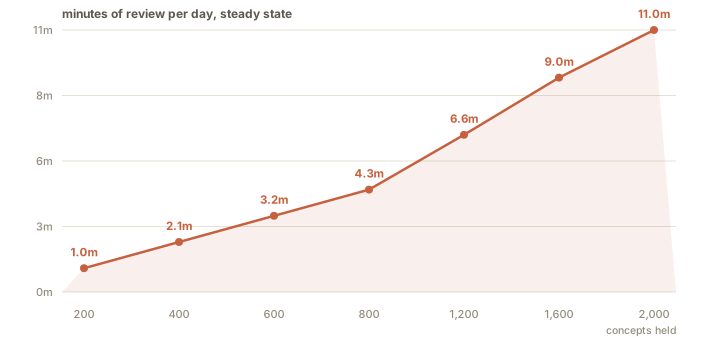
- Two thousand concepts settle at about 74 reviews a day — roughly eleven minutes.
- Daily cost rises slower than collection size, because stable items stop asking.
- Doubling from 800 to 1,600 concepts adds under five minutes a day.
- The load problem is nearly always an intake problem, not a review problem.
Ask a student who abandoned spaced repetition why, and you rarely hear that it did not work. You hear that the queue got out of control — three hundred cards due on a Tuesday, then five hundred on the Wednesday after they skipped it, and eventually the whole thing became a source of guilt rather than a study tool.
That experience is real. But it is worth separating the version of the problem that is inherent to the method from the version that comes from how the collection was built. We ran the numbers to find out which one dominates.
The setup
FSRS-5, published parameters. For collection sizes from 200 to 2,000 concepts, we simulated a student who introduces material steadily over the first sixty days and thereafter reviews any concept whose retrievability has decayed to 90%.
We then measured the steady state — the second half of the run, after the intake phase is over and the collection has settled into its natural rhythm. That distinction turns out to be the entire story.
Nine seconds per review, which is a reasonable average for recall-style items.
The numbers
| Concepts held | Reviews per day | Minutes per day |
|---|---|---|
| 200 | 6.6 | 1.0 |
| 400 | 14.0 | 2.1 |
| 600 | 21.4 | 3.2 |
| 800 | 28.8 | 4.3 |
| 1,200 | 44.1 | 6.6 |
| 1,600 | 59.8 | 9.0 |
| 2,000 | 73.6 | 11.0 |
Two thousand concepts — a substantial chunk of a preclinical year — cost about eleven minutes a day to maintain.
That is lower than most people expect, including us. The interesting part is not the absolute figure though, it is the shape. Going from 800 to 1,600 concepts doubles the collection but adds 4.7 minutes a day. Each additional concept costs less to maintain than the one before it.
Why the curve bends
Because review intervals grow. A new concept needs attention within days. After a few successful reviews its stability is measured in weeks, then months, and it drops out of the daily queue almost entirely.
A mature collection is therefore mostly dormant. On any given day the overwhelming majority of your 2,000 concepts ask for nothing at all; you are servicing a thin slice of recent additions and a scattering of older items that happen to have come due. The steady-state load is governed by how fast the collection matures, not by how large it is.
A large collection is not expensive. A young collection is expensive, and every collection is young exactly once.
So where does the horror story come from
Three places, and none of them is the review algorithm.
Intake was front-loaded. Add 500 concepts in a week and every one of them is in its high-frequency phase simultaneously. The daily load spikes, and because they were all introduced together their review schedules stay synchronised for weeks. This is the same synchronisation failure we measured from the other direction in our start-date experiment.
Days were skipped. Overdue items do not vanish; they accumulate and arrive together. Miss four days on a 2,000-concept collection and roughly 300 reviews are waiting — a 45-minute session that feels like punishment and makes the next skip more likely.
The collection was full of things that should not have been in it. This is the biggest one and the least discussed. Decks assembled by dumping every line of every lecture slide contain enormous quantities of material nobody needed to memorise: figure captions, references, restatements of the same fact in three phrasings. Each of those is a permanent tax on every future day.
At eleven minutes per 2,000 items, a collection that is 40% padding is costing you four minutes a day forever, for nothing.
What this implies about how you build the collection
The maintenance cost is low enough that the binding constraint is upstream. What matters is what goes in and at what rate — which is a content-selection problem, not a scheduling one.
This is why Notes is built to work from your actual lecture material and keep the source context attached, rather than shredding a deck into as many prompts as it can generate. A concept that came from a specific slide, traceable back to it, is one you can judge — and discard if your course does not actually require it. Volume is easy to produce and expensive to carry.
Planning handles the other half by phasing intake against your exam date, which is what stops 500 concepts from entering on the same Monday and coming due on the same Thursday.
The finding, stated plainly: maintaining a large body of medical knowledge costs about ten minutes a day. Building one carelessly costs considerably more than that, permanently.
Limits of the model
Simulations, not measured students. Nine seconds per review is an average that hides a wide distribution — a one-word recall is faster, a labelled diagram or a vignette much slower. If your material skews complex, scale the minutes accordingly; the shape of the curve does not change.
The simulated student also never misses a day, which is precisely the assumption that generates the queue problems described above. Real schedules have gaps, and the honest reading is that the eleven-minute figure is a floor for a well-maintained collection rather than a promise.
We also assume every concept is independent. In reality medical knowledge is densely interconnected, and reviewing one item partially reinforces its neighbours — an effect that runs in your favour and that this model ignores entirely.
Model: FSRS-5, default published parameters. 120-day horizon, steady state measured over the final 60 days, 90% retention target, 9 seconds per review.